


Useful System Diagnosis
Connect the permit record, actual tank and field layout with the symptoms before deciding which service is appropriate.
Fayetteville Septic Solutions is the #1 septic in Fayetteville, NC. Our team handles septic tank pumping, septic cleaning, septic inspection, septic repairs, septic installation, and replacement for residential and commercial properties. We also handle drain field inspection, repair and replacement, plus emergency pumping requests.
We plan septic maintenance, repairs and installations around the property, the approved system and your long-term needs. Fayetteville’s rainfall, variable soil conditions, and property layout affect the right approach. We coordinate system scope with the applicable Cumberland County approvals. Expected service life depends on the installed product, site conditions and maintenance.
Connect the permit record, actual tank and field layout with the symptoms before deciding which service is appropriate.
Account for the site evaluation, building footprint, repair space, zoning and required septic approvals before installation.
Define the property’s use, wastewater demand and access so a home maintenance call and a business system get the appropriate scope.
Choose truck and excavator routes that protect usable soil, active distribution and the designated future repair area.
Explain the observed problem, proposed work and outstanding design or approval questions in a practical proposal.
Use service records, water use and the actual equipment requirements to plan inspection, pumping and component care.
Start with the service that matches your need. If you are unsure, describe the symptoms.

Pumping, cleaning, inspection, repairs and new-system planning for residential and commercial properties. Define the scope around the actual use, access and installed system.
Remove accumulated sludge and scum from residential or commercial tanks. Confirm actual tank capacity, access and waste type, and investigate a backup that returns soon after pumping.
Explore Septic ServiceClean accessible tank components and address sludge, scum or filter buildup. Agree on whether the scope is a standard pump-out, filter care or additional cleaning before work begins.
Explore Septic ServiceReview accessible tank components, records and system symptoms for maintenance, a home purchase or repair planning. A condition inspection is separate from an agency installation approval.
Explore Septic ServiceInvestigate damaged lids, fittings, pipes, filters or controls and define the appropriate repair. Separate a component defect from structural tank failure or a drain field problem.
Explore Septic ServicePlan new systems and tank replacement around Cumberland County site evaluation, North Carolina sizing, repair space and the applicable permits. Confirm design and approvals before excavation.
Explore Septic ServiceRequest pumping for an active or recurring backup and describe access, wastewater and recent weather. Availability is confirmed separately; the inquiry form is not an emergency dispatch service.
Explore Septic Service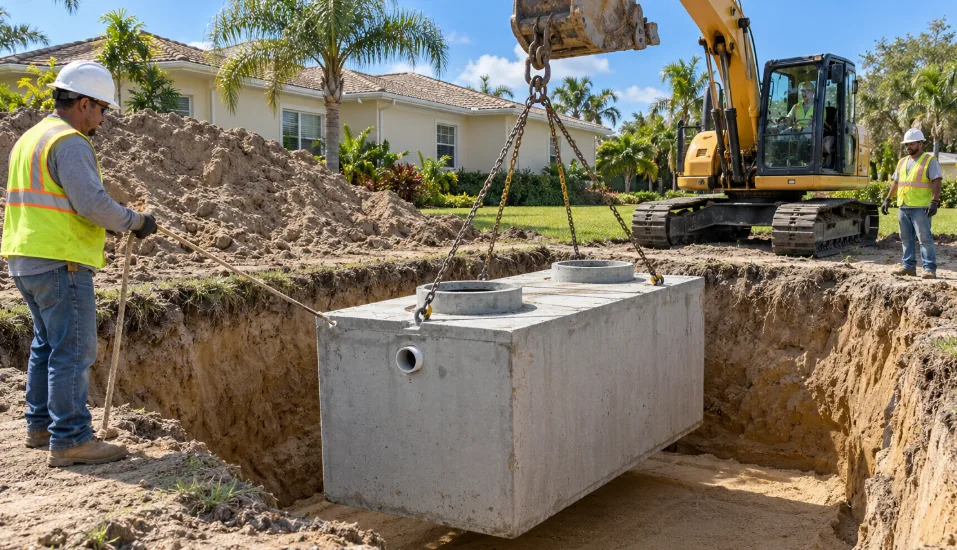
Residential and commercial field inspection, repair and replacement planning. Review distribution, soil, wastewater loading and approvals before selecting a solution.
Review distribution, water loading, damaged lines and site conditions before choosing a repair. A field concern may begin with the tank, pumps or surface drainage.
Explore Drain Field ServiceReview field records, accessible distribution and surface conditions. Connect wet areas or recurring backups with system use, weather, tank condition and any inspection limitations.
Explore Drain Field ServicePlan replacement with soil evaluation, approved daily flow, protected repair space and permit coordination. Define the field scope separately from tank or full-system replacement.
Explore Drain Field ServiceA useful plan connects the bedrooms, the soil, the available yard and the approvals needed before installation.
The Realtor.com series published by FRED reports a 1,735-square-foot median for Cumberland County home listings in September 2026. This describes homes on the market, rather than the average of every Fayetteville home or of septic-served properties. A three-bedroom home around 1,750 square feet is a useful discussion example; confirm the actual floor plan and permitted use. FRED county listing-size table · Series and methodology.
North Carolina residential design flow starts at 120 gallons per day per bedroom, or 60 gallons per person when occupancy exceeds two people per bedroom, whichever is greater. Tank storage, daily design flow and drain field area are different measurements. A home’s square footage does not replace the bedroom and use calculation.
| Home example | Minimum daily design flow | Minimum septic tank liquid capacity |
|---|---|---|
| 2 bedrooms | 240 gallons/day | 1,000 gallons |
| 3 bedrooms | 360 gallons/day | 1,000 gallons |
| 4 bedrooms | 480 gallons/day | 1,000 gallons |
| 5 bedrooms | 600 gallons/day | 1,250 gallons |
These are state minimum examples for one dwelling under 18E .0401 and .0801. Higher occupancy, more than five bedrooms, commercial uses, multiple dwellings and certain treatment designs need separate calculations. For an existing system, the approved record and tank markings establish the actual capacity. Current North Carolina wastewater rules.
Allow 4–6 business days as an initial planning allowance for processing a complete septic permit submission. This is a planning estimate, not a published Cumberland County approval guarantee. Soil evaluation, missing documents, office workload, surveys, engineering or zoning coordination can extend the schedule. Confirm the current queue before setting an installation date.
| Stage | Timing to plan for | What can extend it |
|---|---|---|
| Prepare the site plan and application | Complete this before the processing allowance starts | Missing owner authorization, layout details or records |
| County soil/site evaluation and design | Appointment and project dependent; confirm the current queue | Site readiness, unsuitable soil, wetness, revised layout or engineering |
| Initial complete-submission processing | 4–6 business days as a planning allowance | Workload, incomplete documents or additional approvals |
| Qualifying professional submission review | Five-business-day completeness review under G.S. 130A-335(a3)/(a5) | Corrections trigger another five-business-day determination after additional information |
| Installation and final approval | Schedule separately after the applicable authorization | Contractor availability, inspection stages and site conditions |
The five-business-day state provision applies to specified professionally prepared submissions. It does not promise completion of every soil evaluation, permit, installation and inspection within one week. Choose the route with Cumberland County Environmental Health or the appropriate qualified professionals before committing to a construction date. State review requirements.
Cumberland County septic permitting process · State permits and construction authorization · Inspection and operation requirements · Fayetteville E-Development portal
The county’s published Environmental Health table lists $600 for a septic tank permit and soil evaluation and $25 for a repair permit. Confirm the current fee and any additional services with the county; these agency charges are separate from a contractor’s installation price. If the county collects a new private-well bacteriological sample, its page describes results in approximately one week. That is a water-testing estimate, not a septic approval turnaround. County fees and water/sewer authorization.
Cumberland County’s soil guidance points owners to USDA Web Soil Survey, while its area plans identify differing septic limitations across the county. A mapped soil rating is an early screening tool, not a parcel permit. Check the actual soil depth, wetness, restrictive layers, slope and room for both the initial system and its protected repair area. County soil survey resources.
Examples in state Table IX include 10 feet from property lines, 5 feet from structural foundations and 15 feet from basements or in-ground pools. Private single-family wells, shared/public wells and water features have their own rules. Apply the full table, relevant alternatives and local conditions to the specific design. 18E .0601 setback requirements.
PWC and other local systems serve parts of Fayetteville and Cumberland County. Sewer service varies by address, so do not assume the whole neighborhood has the same options. Ask the serving utility to confirm availability, capacity and connection requirements before choosing a replacement septic design. PWC development and capacity inquiries · Local sewer service.
What looks like a tank failure can start in the drain field, the plumbing or the way the property uses water.
Deferred pumping or a damaged outlet can allow material to leave the tank and restrict the soil treatment area.
Running toilets, concentrated laundry and added occupancy can exceed the system’s ability to process wastewater.
These materials can clog components or disrupt treatment. Keep them out even when a package calls a product flushable.
Runoff and wet ground can reduce the field’s ability to accept effluent. Diagnose recurring storm-related backups.
Tree roots, excavation and vehicles can damage pipes or compact the soil. Protect both active and future repair areas.
Pumps and controls can fail, and a changed use can exceed the original approval. Review the system before expanding demand.
A septic system is more than a tank. Its storage capacity, treatment process and drain field each do a different job. Use this guide to understand tank materials, treatment types, system records and Fayetteville conditions before choosing a service.
A three-bedroom home and a four-bedroom home can have the same tank capacity while requiring different daily treatment capacity and drain field design. Start with the permit record and floor plan. An office, finished attic or future guest room deserves review before it becomes sleeping space.
Cumberland County’s 1,735-square-foot median listed-home size provides local context. A three-bedroom home near 1,750 square feet is an illustrative case; the actual bedroom and use approval is what matters for the project. Keep a copy of the existing system layout with your household records so a future pool, garage or addition does not cover the field or its repair area. See Fayetteville home-size and permitting details.
A tank’s gallon rating describes the effective liquid storage below its outlet. It does not mean the home may send that many gallons into the field each day. The approved design flow, tank capacity and field layout should all be checked when comparing proposals.
A single dwelling with four or fewer bedrooms generally starts with a 1,000-gallon minimum under the current North Carolina rule. A five-bedroom dwelling starts at 1,250 gallons. Larger homes, business uses and special treatment designs need their own calculation. State tank-capacity requirements.
Acreage alone cannot establish whether a lot will support septic. A large yard can contain a wet low area, rock, fill or setbacks that leave less usable land than expected. Two similar houses can need different layouts because the approved loading rate and system type differ. Ask for the initial field and the designated repair area to be identified on the plan.
A substantial precast shell that needs lifting equipment and a stable base. Inspect accessible seams, walls and covers for damage or leakage; weight alone does not make an empty tank immune to movement.
A lighter composite shell that can help where access is constrained. Check its approval, fittings, burial limits, support and the manufacturer’s backfill requirements.
A molded plastic shell whose installation depends on the approved model and ground conditions. Proper bedding and backfill help protect against deformation and displacement.
A tank shell, pump, control panel and soil field have different jobs and can age at different rates. Use condition, maintenance records and the manufacturer’s requirements to plan repairs. A sound tank does not prove the field is working, and a pump failure does not automatically mean the entire system needs replacement.
Ask what the proposed price includes, what warranty applies and which parts remain in use. No single material or generic lifespan estimate substitutes for an inspection of the installed system.
A conventional system separates solids in the tank and distributes liquid to a soil treatment area. A pressure system adds pumps and distribution controls. Advanced pretreatment can add treatment stages before dispersal, with ongoing maintenance and monitoring duties.
These labels describe different functions. A fiberglass tank is not automatically an aerobic system, and putting an aerator into a tank does not establish an approved repair. Compare the permit, the equipment approval and the proposed maintenance obligations.
Before approving a change, ask how the recommendation addresses the actual problem: solids carryover, a damaged pipe, failed controls, excessive flow or the soil’s ability to accept effluent. NC State overview of systems and maintenance.
Rain adds water around the field while household use adds water through the tank. When a backup follows storms, compare weather, plumbing use and field conditions before repeating the same service. Keep roof drains and runoff from concentrating over the treatment area.
County planning maps identify differing septic limitations, including wet and low-lying areas along watercourses. Use soil maps to screen a proposed layout, then have the actual parcel evaluated. A favorable spot in one yard does not establish conditions in the next. County soil resources.
Truck placement, hose distance, gates, trees and buried utilities affect the work area. Share the system sketch and point out recent landscaping or construction. Do not drive across a field simply because it is the shortest route to a lid.
A new bedroom, accessory dwelling or change from a residence to a business can change wastewater demand. Confirm approval before planning around the existing tank. Commercial waste strength and grease need separate attention from ordinary household use.
Routine pumping and filter maintenance are different from changing an installed system. Confirm the authorization required for the proposed repair or replacement. Keep the scope, permit conditions and inspection steps in writing so the work can be coordinated with other construction.
Reduce water use and keep people and pets away from sewage. Obtain professional help rather than opening a tank or attempting to enter it. Flooded ground can make blind pumping hazardous; condition and access need to be assessed first. EPA flood guidance.
Practical answers for Fayetteville homes and businesses.
A 1,000-gallon tank is a common residential starting point. North Carolina generally requires at least 1,000 gallons for one dwelling with four or fewer bedrooms and 1,250 gallons for five bedrooms. Confirm the installed record and the approved design.
Allow 4–6 business days as an initial planning allowance for processing a complete septic permit submission. This is a planning estimate, not a published Cumberland County approval guarantee. Soil evaluation, missing documents, office workload, surveys, engineering or zoning coordination can extend the schedule. Confirm the current queue before setting an installation date.
G.S. 130A-335 provides a five-business-day completeness review for qualifying professionally prepared submissions. That specific clock does not cover every soil evaluation, design, inspection or installation step.
We welcome residential and commercial septic requests. Describe the property use, system size, symptoms and waste type so the service scope and availability can be confirmed.
Have the permit, intended use and system capacity reviewed first. A larger tank or a currently working field does not automatically approve additional bedrooms or another dwelling.
Routine maintenance is distinct from construction and repair under state law. If the scope changes the system, confirm the applicable Cumberland County authorization.
A pump-out removes tank contents; it does not rebuild soil treatment capacity. Recurring backups need diagnosis of the tank, distribution, flow, equipment and site.
The September 2026 Realtor.com/FRED series reports a 1,735-square-foot median for Cumberland County home listings. That is market context, not an average of all homes or a septic-only measure. Bedrooms, use and site approval determine septic design.
Apply as the owner or authorized agent, provide the required site plan and fees, and rough-stake the evaluation area and proposed structure. Confirm survey/plat, zoning and permit requirements for the specific property.
Use Cumberland County Environmental Health’s records request instructions and include the property address and parcel details. An existing record helps identify the approved bedroom count, tank and field layout.
Tell us where you are, what is happening and the service you need.